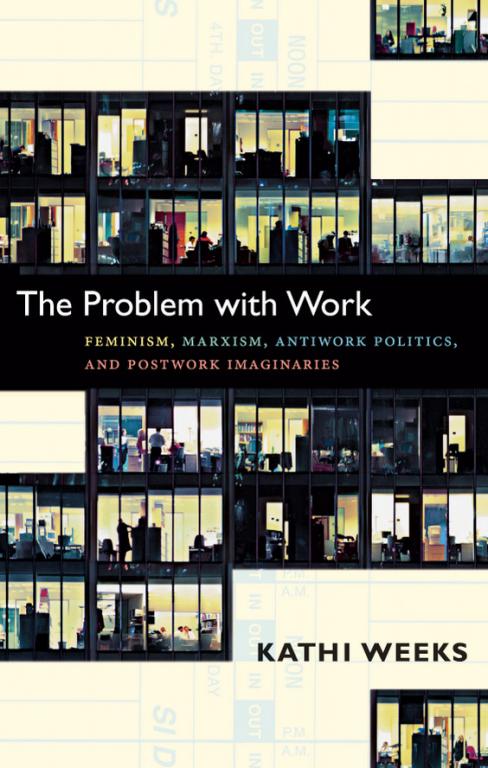
From The Problem with Work, available at libcom.org
"The difference between the concepts [work and class]* is perhaps most starkly posed when
work understood as a process is compared to class conceived in terms of
an outcome that is, as a category (whether explained by reference to
ownership, wealth, income, occupation, or forms of belonging) designed
to map patterns of economic inequality...
... Iris Young once argued in favor of substituting the Marxist category of
division of labor for class as a primary analytic of Marxist feminism.
In this classic contribution to second-wave Marxist feminism, Young
describes at least two advantages of this methodological shift. First,
the division of labor has at once a broader reach than class and allows a
more differentiated application. Not only can it be used to register
multiple divisions of labor by class as well as by gender, race, and
nation, but it can, as Young explains, also expose "specific cleavages
and contradictions within a class" (1981, 51; emphasis added) not just
along the lines of gender, race, and nation, but also, potentially, of
occupation and income...
...Like the division of labor, the category of work seems to me at once
more capacious and more finely tuned than the category of class. After
all, work, including its absence, is both important to and differently
experienced within and across lines of class, gender, race, and nation.
In this sense, the politics of and against work has the potential to
expand the terrain of class struggle to include actors well beyond that
classic figure of traditional class politics, the industrial
proletariat. Consider too the second advantage noted by Young: "The
category of division of labor can not only refer to a set of phenomena
broader than that of class, but also more concrete." Unlike class, by
her account, the division of labor "refers specifically to the activity
of labor itself, and the specific social and institutional relations of
that activity' proceeding thus "at the more concrete level of particular
relations of interaction and interdependence in a society" (51). By
this measure, whereas class addresses the outcome of laboring activity,
the division of labor points toward the activity itself...
...Here too there are similarities between Young's interest in the category
of division of labor and my focus on work: after all, work, including
the dearth of it, is the way that capitalist valorization bears most
directly and most intensively on more and more people's lives. This
politics of work could be conceived as a way to link the everyday and
sometimes every-night experiences of work its spaces, relations and
temporalities; its physical, affective, and cognitive practices; its
pains and pleasures to the political problematic of their present modes
and codes of organization and relations of rule. Although the category of class remains analytically powerful, I would
argue that its political utility is more negligible. The problem is that
while the oppositional class category of the industrial period the
"working class" may accurately describe most people's relation to waged
labor even in a postindustrial economy, it is increasingly less likely
to match their self descriptions. The category of the middle class has
absorbed so many of our subjective investments that it is difficult to
see how the working class can serve as a viable rallying point in the
United States today. A politics of work, on the other hand, takes aim at
an activity rather than an identity, and a central component of daily
life rather than an outcome...
...So in the end, I am not saying that we should stop thinking about class,
but rather that focusing on work is one politically promising way of
approaching class because it is so expansive, because it is such a
significant part of everyday life, because it is something we do rather
than a category to which we are assigned, and because for all these
reasons it can be raised as a political issue. By this account, work is a
point of entry into the field of class analysis through which we might
be better able to make class processes more visible, legible, and
broadly relevant and, in the process, perhaps provoke class formations
yet to come."
*work here is understood as including unwaged and reproductive work.
Tuesday, January 15, 2013
Sunday, January 13, 2013
Labour History Project Newsletter 55
Check out the latest available newsletter of the Labour History Project (New Zealand), featuring a range of recent and current research, feature articles, news, reviews and more. Includes articles on the Socialist Cross of Honour, the Runanga Miners Hall, political folk music in New Zealand, and more.
Friday, December 21, 2012
Socialist Cross of Honor: markings of a working class counter-culture
![]() |
| Socialist Cross of Honor #5 |
In July 1911 William Cornish Jnr, a young conscientious objector from Brooklyn, Wellington, stood before Magistrate Riddell on charges of refusing to register under the Defence Act of 1909. Amended in 1910 and finally enforced in April 1911, the Act required compulsory registration of all men between the ages of 14 and 30 as an “attempt to re-organize [New Zealand’s] defence forces along the lines agreed to at the Imperial Naval and Military Conference” held in London in 1909.1 Cornish Jnr, having “no intention of obeying the law” and “prepared to take the consequences,” refused to pay the £4 fine. Instead, he was sentenced to 21 days in jail—becoming, according to Ryan Bodman, the first Pakeha political prisoner in the nation’s history.2
William Cornish Snr shared his son’s sentiment and echoed the rumblings of an antimilitarist movement gathering momentum—a movement angered by creeping militarism and state curtailment of liberty. “What is this terrible offence for which my son is punished?” wrote Cornish Snr to the Evening Post. “He refuses to register himself like a dog. A dog registered and collared!” He concluded defiantly:
My son is told to defend his country. He has got to defend his father’s property. And how much property has his father got? None. Nine-tenths of the working class—the class I belong to—have no property; therefore it means that the ruling class—the capitalists—have got the cheek and impudence to ask the sons of the workers to defend their property… I am happy and proud to be the father of such a noble son who has the courage to say: No! No! No!”3
Harry Cooke, son of the New Zealand Socialist Party’s (NZSP) Christchurch secretary Fred Cooke, was another young objector who said “No! No! No!” to the fine and was sent to jail. He was not the last. Backed by antimilitarist groups like Louise Christie’s Anti-Militarist League and Charles Mackie’s National Peace Council, along with working class bodies such as the NZSP, the Federation of Labor and the Passive Resisters’ Union (PRU), youths across New Zealand were refusing registration and compulsory military training in large numbers. By 1913 the Maoriland Worker, which started a ‘Roll of Honour’ on the jailing of Cornish Jnr, had 94 names listed (many with double sentences), while prosecutions under the Act had reached a figure of 7030.
Yet despite the statistics, antimilitarist ‘shirkers’ and ‘anti-defenders’ were in the minority—a movement on the margins of a highly conformist culture. They were often ridiculed by the mainstream press—“we have precious little sympathy with the silly, notoriety-craving youths,” wrote one scathing editor.4 Therefore, the support of collective associations like the NZSP and the PRU formed an important part of resisting militarism in its various forms, and dealing with the reprisals. With the creation of these associations came a working class counterculture with its own institutions, values and symbols, a “means of defining and winning space within the social structure.”5 Newspapers, banners, badges, slogans, songs, social events, physical spaces and social relationships were just some of the ways working people expressed their solidarity. PRU members wore distinctive red, white and gold badges on their jackets, published the spritely Repeal and had their own hockey team “with bright red uniforms and big crowds to watch them on Saturday which highlights the popularity of their cause.”6 The NZSP had its halls, Sunday schools, stationery (“the red flag and Socialist motto being very prominent”) and in 1912 even considered purchasing their own van.7
So when Cornish Jnr and Harry Cooke were imprisoned, the communities of which they were a part rallied together in true countercultural fashion. Although a demonstration planned at the prison gates was foiled when Cornish Jnr was released an hour early, the Wellington socialists threw two receptions for him at the Socialist Hall. The first, attended by a crowd of over 300, saw Cornish Jnr receive a medal from the Runanga Anti-Conscription League—possibly the first celebratory medal of its kind in the history of the New Zealand labour movement. Speaking on behalf of the League, Robert Semple “congratulated Cornish on defying an immoral law” before presenting him “with a handsome gold medal, which bears the following inscription:—‘Presented to W. Cornish, junr., by the Runanga Anti-Conscription League. 26/7/11.’”8 The following night saw Cornish Jnr receive a second medal – the Socialist Cross of Honor:
The design of this cross is based on the Victoria Cross. On the centre shield are engraved the name of the NZ Socialist Party, the number and the name of the boy. In the centre are a red flag and the words ‘Anti-Militarism’ and at the bottom is written ‘For Courage’”9
Cooke received his Socialist Cross in a similar ceremony a month later, presented by the Christchurch NZSP in front of a crowd of 200.
![]() |
| Cornish Jnr, as pictured by Bloomfield |
It is not known how many of these unique medals were produced. By mid-1912 the NZSP was appealing for funds to keep the practice going: “there are a number of crosses in the course of being finished, and by appearances we shall require a larger number than was anticipated.”12 References to the Socialist Cross disappear from the Maoriland Worker after June 1912 and they are missing from collectors-catalogues such as Leon Morel’s Catalogue of Medals, Medalets, Medallions of New Zealand, 1865-1940. It appears none are held in any cultural heritage institutions, making them even rarer [Edit: in August 2014 Te Papa relocated one in their collection: http://collections.tepapa.govt.nz/Object/113904].
So imagine my surprise when, after giving a talk on New Zealand’s labour movement at Occupy Christchurch (in walking distance of the PRU’s former headquarters, the Addington Railway Workshops), I was approached by a man named Walter Dobbs claiming to have PRU badges in his possession. At that stage I had no idea any such medals existed, and assumed Walter simply meant the gold PRU badges worn by its members. Instead, in his Addington storage unit, he presented me with not one but two Socialist Crosses. A cross with the faded inscription #24 was in poor condition, but the Socialist Cross of Honor #5, given to PRU founder James Kirkwood Worrall after imprisonment on 5 March 1912, was as good as new.
![]() |
| The Worrall brothers wearing their PRU ribbons |
It is now the morning of July 2, and ten of us have refused the fifth meal offered us. Three of our number are ill, one seriously. It makes no difference, however, as we have decided that unless we are allowed to return to the barrack room and given our full rations, we will be carried off the island dead, or as near dead as our tormentors will allow us to get… Our message to you, our comrades, is to fight hard. No quarter! No compromise! No surrender! We are prepared to play the game to the last: all we ask is for you to do the same. Let the world know that this little country is game enough to challenge the power of the military autocracy which is threatening to overwhelm the world, and is ruining the workers of the world.14
Massey called an immediate Cabinet meeting and the following day promised the conference that conditions on the island would be improved, military drill would not be enforced and inquiries into all complaints would be made. Although not the unconditional release originally demanded, the hunger strikers and resulting publicity had won their point.15
These letters give a rare insight into the fraught activity of antimilitarists like Worrall and highlight the importance of both collective and family support, the latter being a key but under-examined institution.16 “With your letters time passes fairly quickly,” wrote Worrall to his mother, just after the hunger strike,
I received Father’s note, and was very disappointed that he could not come across… I hope that Father left the fruit across there, because I feel fit to eat some. Perhaps you may be able to come another day this week—try, anyway, because I want Father to see the place. Don’t forget to make things hot outside. I will write more soon. Don’t worry, we will win yet. Don’t forget the fruit. W Hooper and I are waiting for it.17
Likewise, the Socialist Cross and corresponding letters shown to me by Walter highlight how much important archival material relating to the labour movement exists in private collections, its value often unknown to their owners. Sadly, in a time of cuts and mergers, archival outreach is often the last thing on a heritage minister’s mind. That is why labour history and accounts of our working past are important—the continuation of a working class counter-culture held dear to those that struggled to create it. As Fred Cooke wrote in 1911, “in the future, when working-class history comes to be written, our Cross will be held in high esteem.”18
ENDNOTES
1. R.L. Weitzel, ‘Pacifists and Anti-militarists, 1909–1914’, New Zealand Journal of History, 1973, p.128.
2. Maoriland Worker, 14 July 1911; Ryan Bodman, “‘Don’t be a Conscript, be a Man!’ A History of the Passive Resisters’ Union, 1912-1914”, Masters Dissertation, University of Auckland, 2010, p.8.
3. Evening Post, 10 July 1911.
4. Marlborough Express, 7 April 1913.
5. Bill Osgerby, as cited by Alan Howkins. ‘Labour and Culture: mapping the field’ in John Martin & Kerry Taylor, (eds.), Culture and the Labour Movement: essays in New Zealand Labour History, Dunmore Press, 1991, p.26.
6. Maoriland Worker, 28 June 1912. Special thanks to Ryan Bodman for pointing this out to me.
7. NZ Truth, 5 August 1911.
8. Maoriland Worker, 11 August 1911.
9. Maoriland Worker, 25 August 1911.
10. Maoriland Worker, 12 April 1912.
11. Howkins. ‘Labour and Culture: mapping the field’, p.25.
12. Maoriland Worker, 12 April 1912.
13. Bodman, ‘Don’t be a Conscript, be a Man!’, p.21.
14. NZ Truth, 5 July 1913.
15. Bert Roth, ‘The Prisoners of Ripa Island’, Here and Now, November 1954, p.18.
16. Melanie Nolan, ‘Family and Culture: Jack and Maggie McCullough and the Christchurch Skilled Working Class, 1880s-1920s’ in Culture and the Labour Movement, p.164.
17. James Worrall, letter to his mother, 2 July 1913, private collection.
18. Maoriland Worker, 25 August 1911.
Wednesday, November 7, 2012
Leo Woods: Waihi, the Great Strike and the NZ IWW

With the centennial of the 1912 Waihi
Strike upon us, this extract seems timely. It is from a letter written
by Leo Woods to Bert Roth, historian and avid creator of (now highly
valued) records pertaining to New Zealand’s labour movement. Roth may
have been collecting material for his book Trade Unions in New Zealand
(Reed, 1973), or for one of many articles and lectures he produced.
Either way, his letter to Woods and subsequent reply offers an insight
into a number of key struggles during the first decades of the twentieth
century—from the Waihi Strike of 1912, to the First World War, the One
Big Union Council and the Communist Party of New Zealand.
Woods was well placed to provide Roth with
the information he sought. Radicalised in the class struggles of 1911
and 1912, he was ‘hunted by the Police in Waihi’, active in the Auckland
branch of the Industrial Workers of the World (IWW), and during the
Great Strike of 1913 sat on the Thames strike committee. As a Wobbly and
socialist, Woods refused to fight during the First World War and was
‘thrown into one of [Prime Minister] Massey’s concentration camps,
Kiangaroa Prison Camp, near Rotorua’ for 18 months. Upon his release in
1919 he was among those who formed the One Big Union Council, becoming
literary secretary and delegated to smuggle banned literature from
Sydney until 1921, when he and other Wobblies formed the Communist Party
of New Zealand. Woods remained a member for over forty years, writing
‘Why I am A Communist’ in 1968.
Written in November 1960, the following
extract is the first four sections of what Woods titled ‘The Labour
Movement’, and is archived in the Roth Collection, MS-Papers-6164,
Alexander Turnbull Library (Wellington).
THE LABOUR MOVEMENT
Waihi Socialist Party
If my memory serves me right in the year
1910, but definitely 1911 and 1912 Waihi boasted the existence of a
Socialist Party, and together with the militant Waihi Miners’ Union
invited socialist and labour leaders near and far, who addressed massed
meetings in the Miners’ Union Hall at the weekends. The first person I
had the honour to listen to was the great socialist leader Tom Mann, who
declared he was a revolutionary socialist. Then followed Ben Tillett
and Alderman [Edward] Hartley. The strike year 1912 attracted more
speakers chief among whom were a person named [Harry] Fitzgerald, a
brilliant orator, and one Jack [John Benjamin] King, a visitor from USA
who [illegible] the principles of the IWW (Industrial Workers of the
World). He formed an economic class on Marxism and delivered several
lectures. He made a great impression on the miners. After he left NZ for
Australia, Prime Minister Massey was going to deport him. Other notable
leaders who came to Waihi were Tom Barker (IWW), H Scott Bennett, great
social reformer and member of Auckland Socialist Party, H E Holland,
Robert Semple, Paddy Webb, Peter Fraser, R F Way and others.
Waihi Strike
In may 1912 the Waihi Miners went on strike
against the action of a section of the union, some but not all of the
engine-drivers in the union breaking away from the union and forming a
‘scab’ union. These boss inspired stooges were used by the mining
companies to smash the militant class-conscious union which had won
concession after concession from the companies in round-table
conferences. Earlier the miners by ballot had discarded the Arbitration
Court as an instrument of the employing class. The mine owners feared
the growing strength of the legitimate union. The strikers fought on for
8 1/2 months, displayed a magnificent spirit of solidarity. The heroism
and pluck of the women folk in standing shoulder to shoulder with the
men was a shining example of courage and dauntless determination. In the
end the strikers were broken by the influx of Premier Bill Massey’s
police thugs who, maddened by liquor (provided by the Tory Government)
batoned the strikers [illegible] and murdered one Frederick George
Evans. Dragged him through the streets and threw him into a prison cell.
He died in hospital a victim of governmental and employers murderous
designs and cruelty, a martyr to the movement of the working class. Many
of the miners were attacked by ‘scabs’ under police protection, and
their property wrecked. Many including myself were forced to leave Waihi
because of the threat of victimisation because we would not be
re-employed. Those who did get back were forced through a searching
screening process. The union President W E Parry and a number of others
were imprisoned because they refused to sign bonds for good behaviour.
But no strike is ever lost because of the spirit of solidarity
manifested and the great boost it gives to trades unionism and the power
and strength it puts into the workers hands. During that strike the
money that was donated by the working class in NZ and Australia ran into
thousands of pounds. That was before capitalistic governments devised
the weapon of freezing union funds.
The General Strike
In 1913 a mass movement of workers staged a
general strike. Watersiders, miners, labourers, seamen, [illegible]
employees and various other trade unions fought for better conditions.
The workers gave the employers the greatest fight of their lives. In the
words of Robert (Bob) Semple Organiser of the Red Federation, that he
would stop the wheels of industry from the North Cape to the Bluff, that
is just about what took place. Labour leaders were again imprisoned.
The ‘Maoriland Worker’ official organ of the Federation of Labour and
the ‘Industrial Unionist’ official organ of the IWW group fought to the
death for the working class, whilst the capitalist press, the Auckland
‘Herald’ and ‘Star’, the ‘Dominion’ and others fought tooth and nail for
their capitalist masters. Once again the money rolled in from
Australian unions and from people who were not on strike in NZ. Strike
committees were set up in strike areas and in non-strike areas alike. In
the latter areas representatives of the strikers spoke and appealed for
funds. In one such area the Thames where a strike committee was set up
with myself as secretary, such speakers as M J Savage (afterwards
Premier of NZ), Ted Canham (Watersiders), Harry Melrose (IWW), Rob Way
and others including local speakers stated the strikers’ case. Once
again the bosses’ stooges formed scab unions. A body (13 men?) could
form a ‘scab’ union and coerce the remainder into joining it. Thus the
strike was again broken. The labour leaders turned to political action,
vote us into power they said and we will legislate for you. You will
never be jailed if you go on strike with a Labour government in power.
But under Prime Minister Peter Fraser (who at one stage led the Waihi
Strike as representative of the Red Federation of Labour) did actually
cause to be jailed ‘[illegible] workers’ who later on went on strike.
How the mighty had fallen!
The IWW
About 1912 a group known as the IWW
(Industrial Workers of the World) was formed in Auckland and other
places in NZ in the most militant areas. Huntly, West Coast of the South
Island, Wellington and elsewhere. The principles of the organization
was the advocacy of Industrial Unionism and the One Big Union. Its
headquarters were in the USA where it had a big following and had very
successful fights with the employing class there. Its preamble went like
this: ‘The working class and the employing class have nothing in
common. There can be no peace so long as hunger and want are found among
millions of working people and the few, who make up the employing
class, have all the good things of life. Between these two classes a
struggle must go on until the world’s workers organise as a class, take
possession of the earth and the machinery of production and abolish the
wages system. [illegible] ‘An Injury to one is an injury to all’.
Instead of the conservative motto ‘a fair days wage for a fair days
work’, let us inscribe upon our banner the revolutionary watchword:
abolition of the wages system.’ The IWW did not believe in parliamentary
action. The chief propagandists in the Auckland group were Tom Barker,
Charlie Reeves, Frank Hanlon (Editor of ‘Industrial Unionist’), Allan
Holmes, Jim Sullivan, Bill Murdoch, Percy Short and Jack O’Brien. Lesser
lights but still [illegible] active participation in the struggle were
Frank Johnston, George Phillips, Lila Freeman, myself, just to mention a
few. The aftermath of the 1913 strike and World War 1 scattered the
members far and wide and the group faded away.
— introduced and transcribed by Jared Davidson for Red Ruffians.
Sunday, October 14, 2012
Waihi Strike Centennial: remembering the radical left
This November the Labour History Project and friends will be marking the centennial of the 1912 Waihi Strike. A number of speakers will be covering the radical left's involvement—such as the Socialist Party and the IWW—which held a minority but strong position, something that many previous accounts overlook or neglect. For example, The Red and the Gold by Stanley Roche doesn't mention the IWW at all... taking her account from Harry Holland saw that figures like JB King were downplayed or written off as extremists. Such an approach was all too common when I was researching Sewing Freedom, despite the very vocal segment of the labour movement who were to the left of the Red Feds.
More information on the event, and a full program, can be found here.
Wednesday, August 29, 2012
Labour History Project Newsletter 54
Open publication
Check out Newsletter 54 of the Labour History Project (New Zealand), featuring a range of recent and current research, feature articles, news, reviews and more. Includes articles on the NZ IWW, Philip Josephs and anarchism in New Zealand, The Maoriland Worker, and wobbly Percy Short.
Subscribe to:
Posts (Atom)


