Pages

Thursday, October 13, 2011

Politics averted: thoughts on the 'Occupy X' movement

Politics averted: thoughts on the 'Occupy X' movement
 An analysis on the protests in Ireland and the US from an Irish anarchist. 

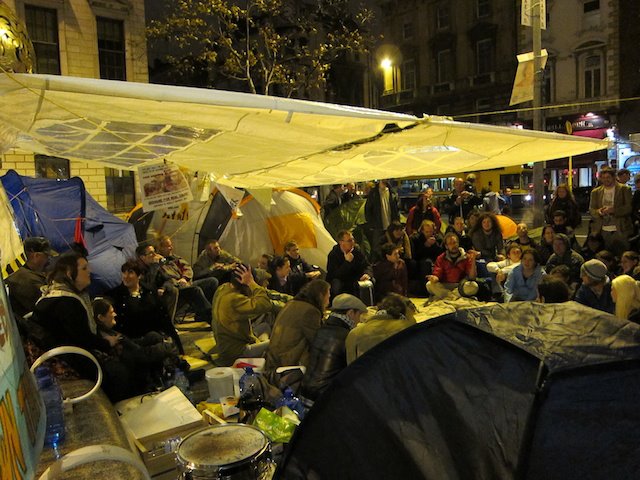
What are we to make of the global 'Occupy X' movement which has exploded onto the streets of cities across the world, turning public spaces into campsites of opposition? Certain things are obvious: Firstly, the fact that there are thousands of people across the world taking over public spaces to express their anger at the financial system is undeniably a good thing. Having camped out outside the Central Bank on Dame Street on Saturday night, I can also say that these protests exude a positivity and hopefulness that is so often lacking from the ritualistic parades of anger that make up most protest marches. But there are also, in my view, serious political problems that prevent the movement from moving beyond a 'radical sleepover' and becoming a genuine anti-austerity grassroots resistance movement.

The analysis below is based in my own particular experience of the Dame St. protest on the ground and of the US protests as a media event. Obviously any attempt to discuss a diverse and fluid movement like this as a whole can only ever be approximate and reductive. This account is not intended to be comprehensive, but rather to sketch what I see as the major trends and tendencies emerging within the movement, and should be read with that in mind.

Non-politics, incoherence, (neo)liberalism
The 'Occupy X' movement has since its inception shown an extreme aversion to being seen as political. Some aspects of this, such as banning political party banners, are an understandable pragmatic reaction to the tendency of various Leninist parties to hijack these kinds of events by swamping them with flags, banners and paper-sellers. But the anti-politics of the movement, at least on the part of the organising core and the Adbusters collective who issued the call for the original Wall St. protest, is also ideological: an odd synthesis of post-leftist anti-organisationalism (which sees formal political organisations, trade unions, etc. as being necessarily oppressive) and neoliberal post-politicism (which sees a Left vs. Right contest of ideas as being largely irrelevant after the fall of the Berlin Wall). After decades of neoliberal governance and media spin attempting to drive ideology and politics out of public discourse in order to enshrine the liberal-capitalist consensus as being 'above politics' and to reduce political questions to technical ones best dealt with by 'experts', it is perhaps unsurprising, but nonetheless disheartening, to see this depoliticisation reflected in contemporary forms of resistance.

Most obviously, this has been expressed in the movement's unwillingness to attempt to agree on a coherent set of positions beyond some very basic points of unity with no underlying analysis of society. Instead, the occupied space is used by individuals to express a range of incoherent and often mutually contradictory ideas which are related only by being in some sense opposed to the status quo and the political and financial elites. On Saturday, I spoke to individuals who believe in everything from Rawlsian social democracy, to anarchism, to paranoid crypto-anti-Semitic conspiracy theories (the New World Order, etc.), to Stalinism. Of course, the advantage of this is that it's extremely inclusive - the only requirement to participate is a sense that things are not as they should be and that the financial sector and the state are in some way to blame - but this also means that reactionary ideas are treated the same as progressive ones rather than being robustly challenged. In practice, this means that the ideas that come to the fore tend to be those that are already dominant in society: the ideas of the ruling class. In the US context, the dominant messages from Occupy Wall Street have been liberal, reformist and nationalistic: those that posed the least threat to the establishment. For example, a call to "make Wall Street work for America" amounts to little more than a call for increased exploitation of the Third World as an alternative to imposing austerity. A call to reform banking practice to constrain "corporate greed" is merely a call to stabilise capitalism so that the course of exploitation runs more smoothly. The problem is capitalism, not regulatory failure, or corporate greed or a lack of economic patriotism, and the inadequacies of these analyses need to be exposed rather than uncritically welcomed. The Irish protest seems to be following a similar pattern, with a particular anti-IMF/EU flavour.

The theory underlying this anti-politics, so far as I can gather, is this: no two people experience oppression in the same way, and thus any attempt to unite people under a political programme inevitably ends up erasing some people's perspectives. This is superficially quite a pleasing analysis, since it creates a framework under which all ideas can be understood as equally valid, since they all derive from lived-experience, but it's extremely problematic. Implicitly, it denies the possibility of coming to an inter-subjective understanding (i.e. one based in mutual recognition of shared experiences and understanding of differing ones) of oppression through collective discussion and compromise, and instead collapses into a naive relativism that produces a vague and weak politics, which plays into the hands of those who wish to dismiss the protesters as 'hippies' who don't understand the complexities of capitalism. In any case, it's easy to overstate the case for subjective perspectives and ignore the objective factors that shape experiences: the processes and structures of capitalist domination.

Bring back the working-class!
One of the major victories of neoliberalism is the eradication of the working-class from the popular consciousness. One of the results of this is the prevalence of the idea among certain sections of the left that the working-class is no longer relevant to understanding power in the modern world - an outdated idea clung to by old-left dinosaurs. This is reflected in the idea of 'the 99%' which has become the slogan of the 'Occupy X' movement, which expresses a very crude understanding of class, where the ruling class are an arbitrarily defined proportion of the wealthiest people in society. This makes for some great chanting - "we are the 99%!" - but is a poor criterion for membership of an anti-capitalist or anti-austerity movement. Put bluntly: there are an awful lot of capitalists, bosses, managers, bankers, CEOs, politicians, police, prison wardens etc. in the 99%.

Properly understood, class is not a classification system of individuals based on how much money they have, it's a social relation between people that derives from the organisation of labour under capitalism. In other words, it's the way people are forced to relate to one another in order to participate in capitalist society. Class oppression is not a small cabal of the ultra-rich in Wall Street or Washington or Leinster House, it's in every workplace, every police station, every dole queue, every courtroom, every prison and every territory occupied by Western militaries, and can only be sensibly understood as such.

Conclusion
The radically democratic nature of the occupations creates the potential for the movement to evolve in any number of possible directions. Whether or not they become genuine resistance movements depends largely on how much the radical left are willing to engage with them, and re-assert the importance of class politics in understanding and countering oppression, by participating in the actions, discussions, and assemblies. A key hurdle has already been overcome: people are on the streets, expressing their dissent, reclaiming public spaces; it remains to be seen what comes of it.

Originally: October 12, 2011 on Workers Solidarity Movement

Monday, October 10, 2011

The Amsterdam Archives (2011)


In January 1939, the CNT-FAI special services secured 22 boxes of the CNT’s archives just prior to the occupation of Barcelona by the fascist forces of General Franco, and transferred them across Europe to the International Institute of Social History in Amsterdam. This Catalan TV3 documentary (with English subtitles) weaves a thrilling visual tapestry of the CNT’s relations with the international anarchist movements of the day, including the Makhnovists in the Ukraine and the revolutionary movement in Patagonia. It not only talks about anarchism and its history—as well as a sort of anarchism 101—but it looks at the role of records management for social causes. It also shows us through some amazing archives!

Friday, October 7, 2011

'Wobblies Down Under': Labour Day feature on Radio New Zealand


While I was in Wellington for the launch of my book, I managed to catch up with Jack Perkins (of Spectrum fame) for Radio New Zealand National. I'm pleased to say our talk has been turned into a 50 minute feature to be aired on Labour Day, October 24 at 10AM.

Songster, poet and member of the radical socialist Industrial Workers of the World, known as the Wobblies, Joe Hill became a martyr for the working classes world-wide. After a funeral in Chicago which attracted over 30, 000 mourners, Joe’s ashes were placed in 600 envelopes with the inscription ‘Murdered by the Capitalist classes’ and sent to Wobblies around the world including New Zealand. No trace of the ashes sent here has ever been found. 'Wobblies Down Under' explores how I set out to track down Joe’s ashes and in the process uncovered a story of the ruthless repression of Wobblies and other socialists in the early 1900s and World War 1.

Featuring music, sound bites from participants in the Great Strike of 1913, and readings from the book, it's well worth a listen. Tune in to 101FM or listen live here:
http://www.radionz.co.nz/national.

Sunday, October 2, 2011

Reproduce & Revolt: stencil & screenprint workshop

 
On October 2 around 15-20 budding street artists gathered for a community workshop on stencil-making and screenprinting, organised by Beyond Resistance. The three hour session involved a run-down on how to make a stencil, the screenprinting process, and of course, making some prints. There were some nice designs being produced, and thanks to the excellent 'Reproduce & Revolt' book, those of us with limited time or handiwork were able to take home some great wee stencils as well. The odd T-Shirt was also printed... Food Not Bombs Otautahi having planned ahead!

Thanks to the Linwood Community Arts Centre for the use of the space, and everyone who came along. Look out for the next workshop soon.

Saturday, October 1, 2011

My screenprinting process

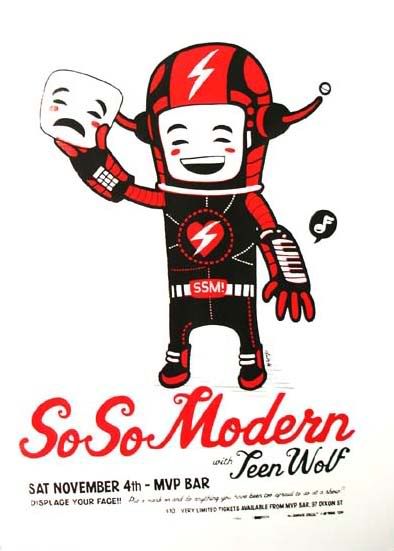
These pics are of an older two colour job for a band called 'So So Modern', designed by Autistk. The poster was printed as an edition of 50 A1's. Hopefully it helps you all understand the screenpritning process a little better.
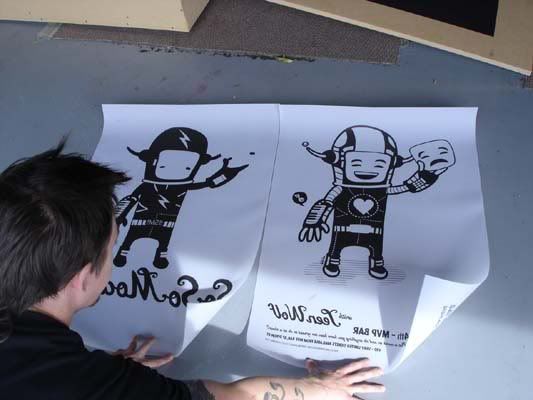


Here's the seperations. These are the designs, turned into their respective colours/layers, as each colour is printed one at a time. Black on the right, red on the left.
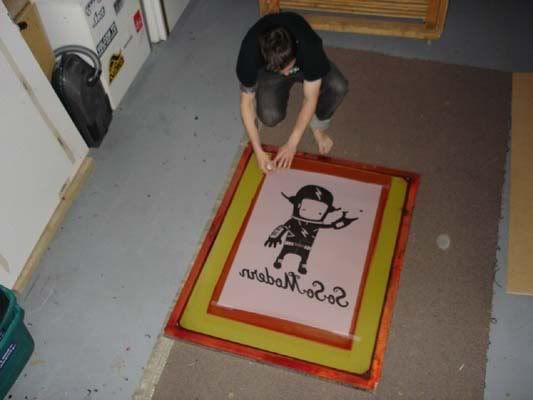

The seps are then stuck to the screen. The key is UV sensitive emulsion (the orange stuff), which is coated onto the screen earlier and needs to be kept out of the light until exposure. I keep my large screens in the attic: smaller screens in a light-safe box I made.
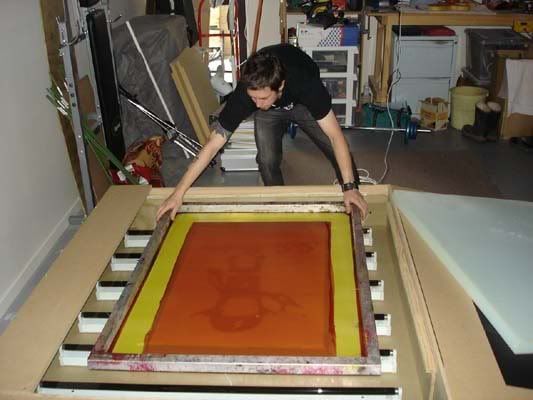

The screen then goes into my UV lightbox for exposure...I use 6 UV bulbs at around 20mins, which burns the design from the seps into the emulsion. The foam on the right pushes the screen flush to the glass when the lid is closed, making a crisp image. You can do this with a halogen lamp, or even the sun.
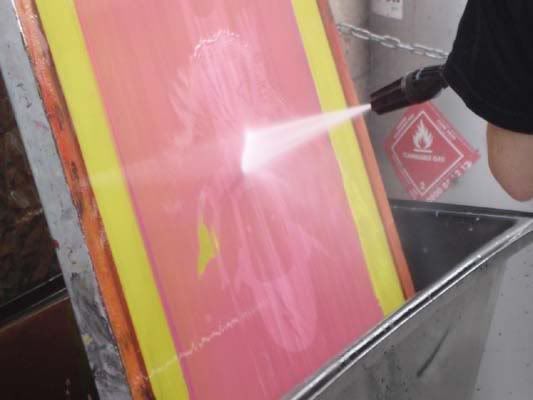


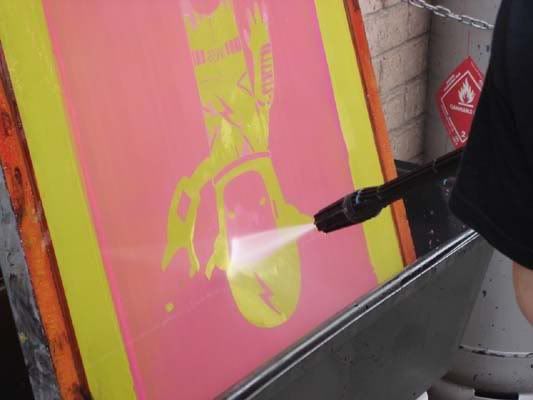
After exposure, the screens are washed down. The black areas in the design block the light, but the clear areas are burned into the screen. The result is that the blocked areas (the yellowish sections) washes away, making the stencil for printing.
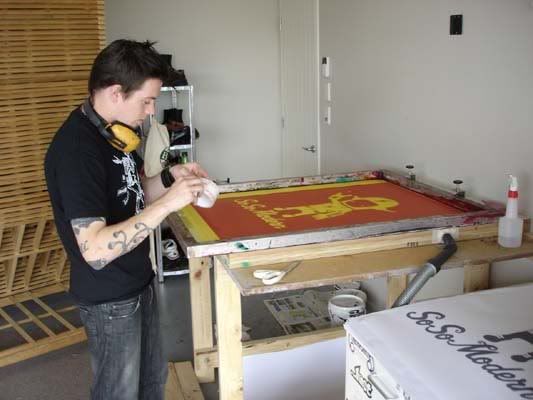

Sweet, so my screen is dry and I'm taping it up so I can print. The orange areas are blocked, so no ink can pass through. It's the other (yellowish) areas where the inks passes through in the printing process.
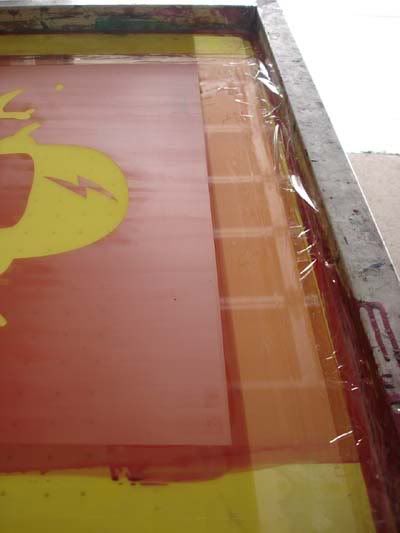

I use clear packing tape on the gutters, which helps cleaning up the excess ink and stops leakage at the sides.
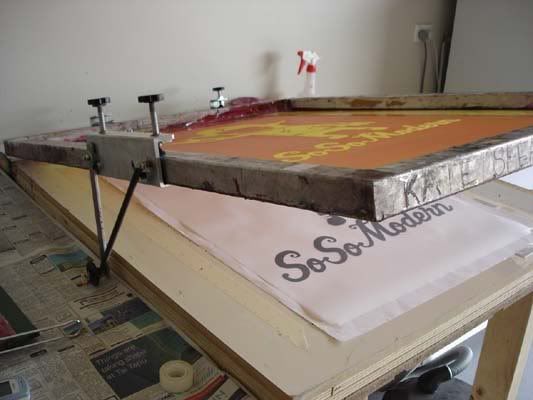

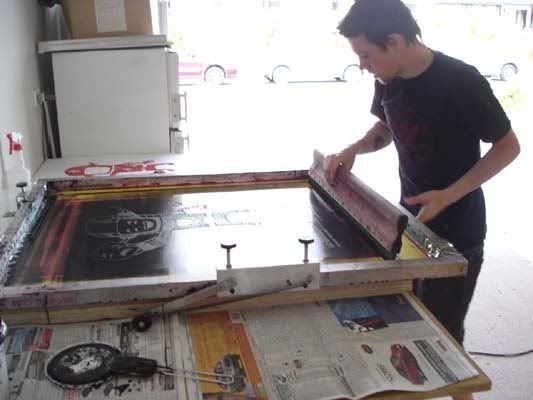
Screen is locked into my vacuum table using hinges, and the stock is ready to register. I use business cards as a 3 point rego system....I also use that kick arm which holds up the screen and helps for feeding in stock.
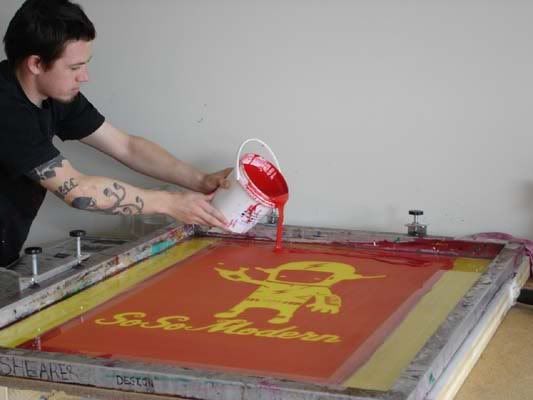

The screen is lowered, and I then add the ink. I use waterbased inks so I don't have to deal with chemicals.
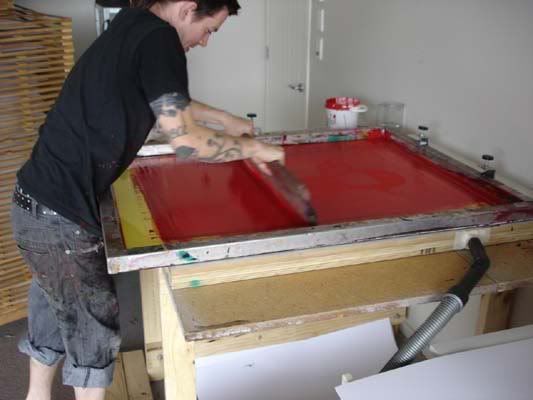

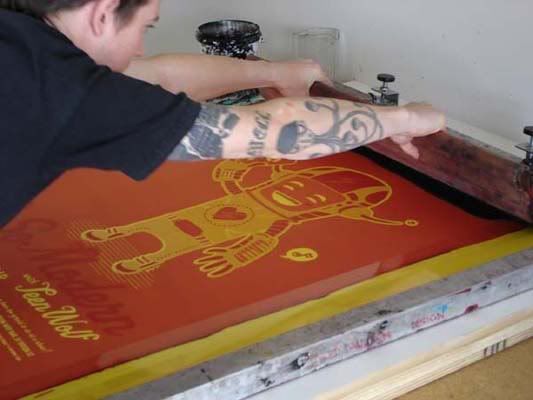
Printing the first layer, red. Generally lighter colours go first. This is the repetitive part. So for a 50 poster job I'd do this action 50 times, plus another 50 for the second colour.
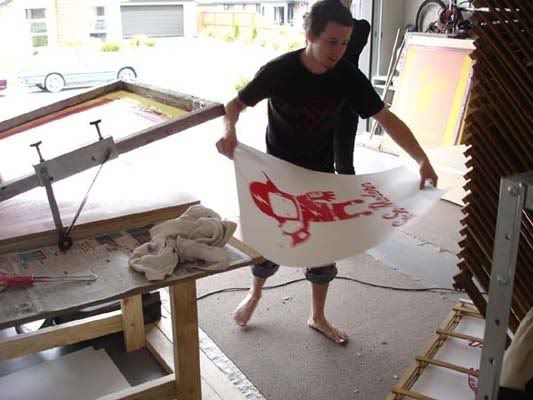

And ta da! I work from right to left, and usually get up a bit of pace, which is nice. Loud punk (Minor Threat usually) or national radio is a necessity for this process.
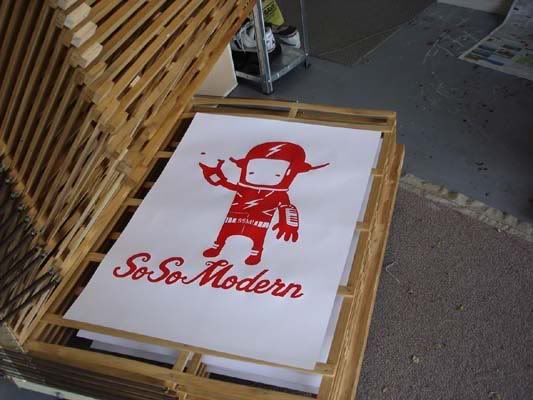

Here's the first colour done.
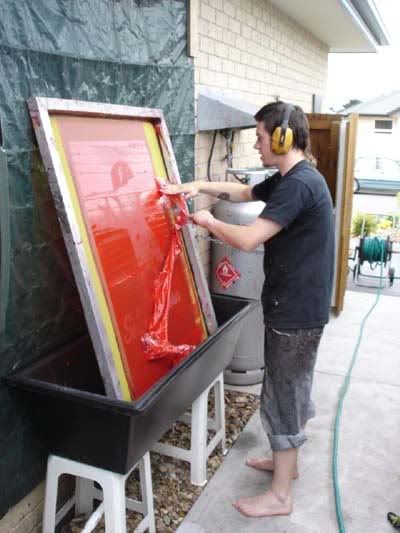

The screens then get cleaned in my washout area out back. Tape, ink, blood, etc.
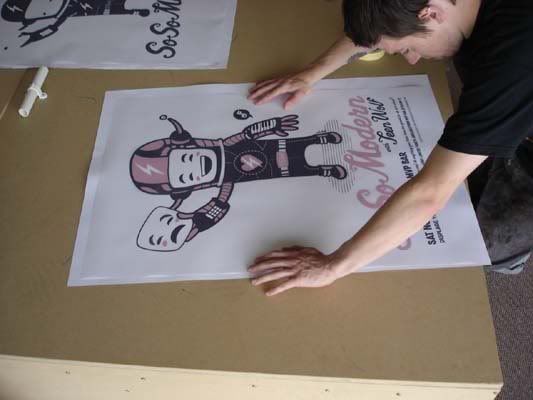

Time for the second colour. I line up the second colour with the transparency, then do the same with the screen to make sure registration is ok. This is probably the hardest thing because things can move during the whole process!
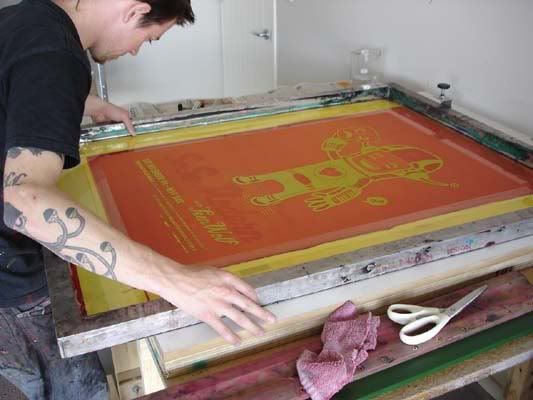

Tape it up, line it up, and get ready to brake my back again. Music on.
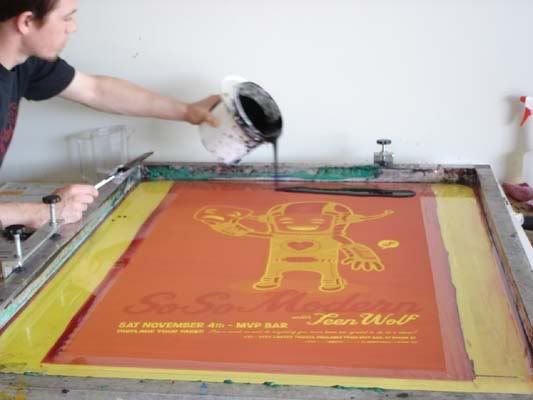


Done!

Tuesday, September 20, 2011

'Remains to be Seen' Auckland launch this weekend

Just a wee reminder that this is happening this Saturday! Also I'm pleased to announce that Radio New Zealand will be airing a 50 minute feature on my research on Labour Day—October 24—at 10am.

'Remains to be Seen: Tracing Joe Hill's ashes in New Zealand'—an easy-to-read account of censorship and radical labour during the First World War—will be launched in Auckland September 24.

Jared Davidson, author and designer of 'Remains to be Seen', will share a few thoughts on the book, to be followed by a screening of 'The Wobblies'—a classic and informative documentary of one of the worlds most lively and radical unions, the Industrial Workers of the World (IWW). You can watch an excerpt here: http://www.youtube.com/watch?v=VS5nP0F8sXI&feature=related

Come along and share in a slice of Aotearoa's radical history.

Saturday 24 September, 5.30pm, at the Cityside Baptist Church Hall (8 Mount Eden Road, Mt. Eden, Auckland).

More information on the book can be found at http://www.rebelpress.org.nz/publications/remains-to-be-seen.

Cheers,

Saturday, September 3, 2011

New Katipo Books webiste is live!


After a wee hiatus, a change in the collective, and a number of major earthquakes, Katipo Books Workers' Co-Operative is finally back on track! And we're excited to say we have a brand new website.

You can now check out radical books, zines and more at http://www.katipobooks.co.nz. We've still got a swag of zines to upload, and a new shipment of books is due in next month, so there's much more to come. And bear with us if there's any bugs.

If you're in Otautahi/Christchurch then watch out for us at the Vegetarian Expo, and if you're keen to get involved then give us a buzz. Our new email is katipobooks (at) riseup (dot) net.

What is Katipo Books?

Katipo Books was established in 2006 as a way to bring more radical and alternative educational material into circulation within Aotearoa/New Zealand. We’re a small collective that aims to grow over time and expand the material we have available, through our online store and regular bookstalls at events such as speakers’ evenings, book launches and other events (such as publishing our own literature). We also support and network with other small publishing and distribution groups such as Rebel Press and AK Press. [Read more at our website]

Wednesday, August 31, 2011

Christchurch Protest: National Party Welcoming Committee!


 For the first time in 16 years the cabinet are meeting outside of the beehive to acknowledge the anniversary of September's Earthquake. The same cabinet that brought us 1000's of families freezing in condemned homes, record levels of unemployment, attacks on workers and beneficiary rights, billion dollar bailouts for private business and a cabinet with a clear agenda to drag New Zealand into a third world economic state - LET'S MAKE IT CLEAR THAT NOT EVERYONE IN AOTEAROA LOVES JOHN KEY AND HIS PARASITIC MATES!!!

Time
: Monday, September 5 · 1:30pm - 3.30pm

 Location: Copthorne Hotel, 449 Memorial Avenue - nr Ch Ch airport

Friday, August 26, 2011

Auckland Launch of 'Remains to be Seen: Tracing Joe Hill's ashes in NZ'

'Remains to be Seen: Tracing Joe Hill's ashes in New Zealand'—an easy-to-read account of censorship and radical labour during the First World War—will be launched in Auckland September 24.

Jared Davidson, author and designer of 'Remains to be Seen', will share a few thoughts on the book, to be followed by a screening of 'The Wobblies'—a classic and informative documentary of one of the worlds most lively and radical unions, the Industrial Workers of the World (IWW). Watch an excerpt here: http://www.youtube.com/watch?v=VS5nP0F8sXI&feature=related

Come along and share in a slice of Aotearoa's radical history.

Saturday 24 September, 5.30pm, at the Cityside Baptist Church Hall (8 Mount Eden Road, Mt. Eden, Auckland).

More information on the book can be found at http://www.rebelpress.org.nz/publications/remains-to-be-seen.