Pages

Wednesday, April 17, 2013

Sewing Freedom book launch: Wellington, 15 May

Sewing_Freedom_launch

Jared Davidson, AK Press, and the Museum of Wellington City & Sea invite you to the launch of Sewing Freedom, a new book on early anarchism and labour history in New Zealand.

Sewing Freedom works on several levels. It is a meticulous biography, a portrait of an era, a sophisticated discussion of anarchist philosophy and activism, and an evocation of radical lives and ideas in their context. Davidson has designed a fresh, crisp book with visual impact, nicely enhanced by Alec Icky Dunn’s wonderful sketches... This beautifully-executed book tells an important story in New Zealand’s political history.” - Chris Brickell, Associate Professor of Gender Studies at Otago University and author of Mates and Lovers


ABOUT THE BOOK:

Sewing Freedom
is the first in-depth study of anarchism in New Zealand during the turbulent years of the early 20th century—a time of wildcat strikes, industrial warfare and a radical working class counter-culture. Interweaving biography, cultural history and an array of archival sources, this engaging account unravels the anarchist-cum-bomber stereotype by piecing together the life of Philip Josephs—a Latvian-born Jewish tailor, anti-militarist and founder of the Wellington Freedom Group. Anarchists like Josephs not only existed in the ‘Workingman’s Paradise’ that was New Zealand, but were a lively part of its labour movement and the class struggle that swept through the country, imparting uncredited influence and ideas. Sewing Freedom places this neglected movement within the global anarchist upsurge, and unearths the colourful activities of New Zealand’s most radical advocates for social and economic change.
More information on the book, a sampler, and reviews, can be found at www.sewingfreedom.org


ABOUT THE LAUNCH:

WHEN: Wednesday 15 May - 5.30PM
WHERE: The Boardroom, Museum of Wellington City & Sea, Queens Wharf, Jervois Quay

Books will be on sale for $15 cash on the night.
Free entry. Nibbles and drinks provided.


ABOUT THE SPEAKERS:
Jared Davidson is an archivist at Archives New Zealand, a member of the Labour History Project, and author of Sewing Freedom. His first book, Remains to be Seen: Tracing Joe Hill's Ashes in New Zealand, was published in 2011.

Barry Pateman is an anarchist historian, Kate Sharpley Library archivist, and Associate Editor of The Emma Goldman Papers (USA). A prolific editor and writer, he has been involved in a number of projects and publications, including Chomsky on Anarchism, A History of the French Anarchist Movement, Emma Goldman: A Documentary History of the American Years, and Anarchist Voices: An Oral History of Anarchism in America.

Mark Derby is the Chair of the Labour History Project and an extensively-published writer and historian, having worked for the Waitangi Tribunal; the PSA; Te Ara, the online encyclopedia of New Zealand; and as South Pacific correspondent for Journal Expresso, Portugal's leading newspaper. His books include The Prophet and the Policeman: The story of Rua Kenana and John Cullen, and Kiwi Companeros, on New Zealand and the Spanish Civil War.

http://www.akpress.org/
http://www.museumswellington.org.nz/museum-of-wellington-city-and-sea/
http://sewingfreedom.org/

Friday, March 1, 2013

Chartist Movement: Labour history talk in Wellington, 6 March


Those of you who live in, or happen next week to be in, Wellington may be interested in the following public talk by Les Kennedy, a British labour historian.

Les Kennedy is a Labour Historian from the UK. He will give a talk on Wednesday 6 March at 6.30 in the Mezzanine room at the City Library, Victoria Street.

Although he is very knowledgeable about the Tolpuddle Martrys, the focus of his talk will be the Chartist Movement.

Les Kennedy has been a life-long trade unionist, his membership of NASUWT, the largest teachers’ trade union in the UK goes back over 37 years and in that time he has been a school representative, local negotiating secretary, national executive member and regional organiser.

He has also worked for the Trades Union Congress where he was responsible for setting up an adult learning centre in Cornwall.

He taught history to 11 to 18 year olds in a state secondary school for 30 years and has also taught adult evening classes. For the last four years he has organised the Radical History school for the TUC at the annual Tolpuddle Festival where he has delivered a number of talks. He has also talked across the UK and most recently at the Workers’ Fest in Hobart, Tasmania.

Les is now retired and lives in Cornwall with his wife Rosemarie and he actively pursues a keen interest in trade union matters.

The details of the meeting are:
6.30pm to 7.30pm

Wednesday 6 March
Mezzanine Floor meeting room
Wellington Public Library
Victoria Street
Wellington

Tuesday, February 5, 2013

Inside story: Alec ‘Icky’ Dunn on his illustrations for Sewing Freedom


Printmaker, writer and Justseeds member Alec Dunn shares his process for illustrating Sewing Freedom. More of his amazing work can (and should) be viewed at his own blog: http://blackoutprint.tumblr.com/

About a year ago I received an email from Jared asking if I’d be interested in illustrating a book he was working on about early New Zealand anarchism. I knew Jared through political art circles, and knew him to be a great designer, producing sharp and tight graphics. I also knew him to be thoughtful about his practice. His politics, graphics, and writing informed one another. So when he asked me to participate in this book I was flattered and agreed right away.

I got a copy of the text, read through it, and began making notes about what stuck out to me visually for each chapter. I did some preliminary sketches and sent these to him as well as a list of ideas for other chapters, just to see if we were on the same page. I originally envisioned the illustrations as sitting on top of the chapter title. I wanted simplistic black and white drawings, and I wanted them to float above the words, no borders, and going full bleed to the edge of the page. That was the first idea at least. I had two, kind of wildly different, approaches to doing this: one was line drawings of the landscapes that Philip Josephs moved through, throughout his life; the other idea, heavily influenced by Gerd Arntz (the German socialist graphic designer who helped create pictograms), would have been a series of generic looking people to represent the different industries and persons involved in the anarchist movement in New Zealand at the time.

We ended up veering more towards the landscapes. And from there I started assembling reference and source images to work from.
Inline image 1
The first one I did was of an agitator speaking before a crowd. I didn’t have a New Zealand source image for this (the image above is from London), but I am familiar with the time and setting and have looked at plenty of pictures from my hometown (Portland, Oregon, US) from the same era. The thing that I always liked about images from protests of that period was the hats. In all those old photographs everyone has a hat, and at labor protests and rallies it was just a sea of hats. So I went with this and decided to make the hats as abstract as possible, with the only delineation being the various hat bands and shawls. The speaker to me was a secondary consideration (and he inadvertently ended up vaguely resembling Josephs).
Inline image 2
From there I worked in order of the book (and chronologically followed Josephs’ life). I did a google image search for ‘Liepaja, 1900, Harbor’ and found a nice colorized postcard. My drawing you can see is almost a direct reproduction. I really liked the pattern of the ship masts and the implication of emigration.
Inline image 3
For the Gorbals neighborhood in Glasgow, I did the same thing, though I may have searched ‘Gorbals, tenements, slums, 1900′. There were a few nice pictures, but the line of tenements, their specific roof-top constructions (I don’t even know the purpose of those bastion-like elements), and their chimneys reads to a very specific geographic place to me.
Inline image 4
I didn’t want them all to be landscapes, so for the next one I focused on his history as a tailor. In any of the images of labor protests from that era there are always a few fabulously-embroidered banners that people are carrying, with symbols from their unions or mottos of their organizations. This one I just did free form.
Inline image 7
And finally I wanted to do a picture of the Te Aro neighborhood in Wellington. I’ve never been to New Zealand, so I used google again, although this time I did street view to find the street where Joseph’s lived. I have a print by Kathe Kollwitz in my apartment called the Four Men In A Tavern, and it’s a silhouette of conspiratorial men. This was an inspiration, I imagined a night scene in Joseph’s house, people plotting something or discussing a pamphlet. Something about this wasn’t working though, but I sent the sketches to Jared to see what he’d think.
Inline image 6
At this point Jared began sending me photos to look through (he wasn’t neglecting me before—I think we agreed to see what was working before I got any specific images from him). There was a great backyard shot of Te Aro that I used as a basis for the final Te Aro drawing and I added in a guy having a smoke and woman hanging laundry.
Inline image 8
Jared sent me a ton of images from New Zealand’s Great Strike of 1913. I tried to go back to an almost flat image of a banner and a man marching—but it kind of sucked! I liked the action of the picture of the cops charging and took the drawing from there. At this point, I still thought that these images would float above the chapter titles.
Inline image 9
The Runanga Miners’ hall was pretty straight forward.
At this point I think Jared decided to go full page with these, and my random dimensions (mostly, but not all, horizontally based) changed to standard (vertical) page dimensions (though, by then, there weren’t that many left to do).
Inline image 10
For the chapter titled ‘Workingman’s Paradise’ I wanted some kind of imagery based on the pictures of miners and lumberjacks that Jared had sent me. I loved this one picture with a bunch of lumberjacks (and one little kid) standing around a giant stump with a banner that said “Lucky Hit”. This ended up being the basis of the image I drew, but I went in a little different direction.
Inline image 11
And the final image I made was of Josephs himself. Jared sent me a portrait of the agitator as a young man (he was handsome one!). I did a few sketches of this. The one I liked—I think the hatching fit in with the more architectural drawings—made him look a little sinister (whereas in the picture he looks kind of charming and pensive). I changed the background on this but it didn’t really change it much. I’m a little embarrassed to say that I eventually threw it into illustrator and abstracted it out a little, which I liked! and which also softened the image some.
Inline image 12
Finally, Jared took the original image of the generic tailor ran with it and, I think, made a great cover.

Tuesday, January 15, 2013

Work and class...

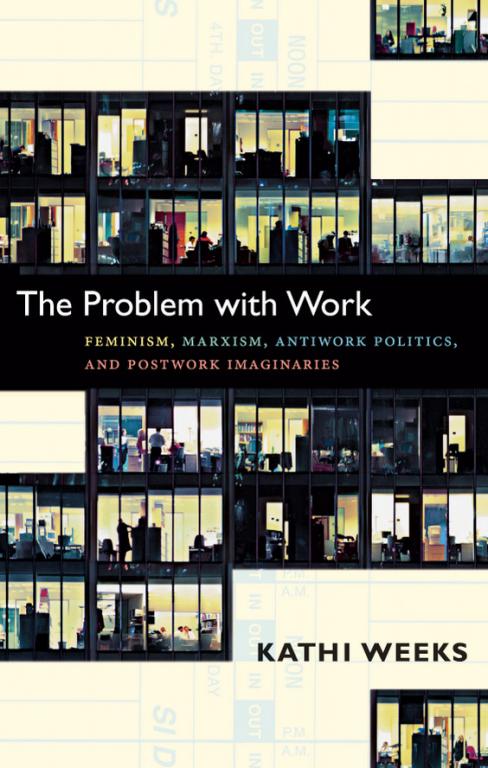
The problem with work: feminism, marxism, antiwork politics and postwork imaginaries - Kathi Weeks
From The Problem with Work, available at libcom.org 

"The difference between the concepts [work and class]* is perhaps most starkly posed when work understood as a process is compared to class conceived in terms of an outcome that is, as a category (whether explained by reference to ownership, wealth, income, occupation, or forms of belonging) designed to map patterns of economic inequality...

... Iris Young once argued in favor of substituting the Marxist category of division of labor for class as a primary analytic of Marxist feminism. In this classic contribution to second-wave Marxist feminism, Young describes at least two advantages of this methodological shift. First, the division of labor has at once a broader reach than class and allows a more differentiated application. Not only can it be used to register multiple divisions of labor by class as well as by gender, race, and nation, but it can, as Young explains, also expose "specific cleavages and contradictions within a class" (1981, 51; emphasis added) not just along the lines of gender, race, and nation, but also, potentially, of occupation and income...

 ...Like the division of labor, the category of work seems to me at once more capacious and more finely tuned than the category of class. After all, work, including its absence, is both important to and differently experienced within and across lines of class, gender, race, and nation. In this sense, the politics of and against work has the potential to expand the terrain of class struggle to include actors well beyond that classic figure of traditional class politics, the industrial proletariat. Consider too the second advantage noted by Young: "The category of division of labor can not only refer to a set of phenomena broader than that of class, but also more concrete." Unlike class, by her account, the division of labor "refers specifically to the activity of labor itself, and the specific social and institutional relations of that activity' proceeding thus "at the more concrete level of particular relations of interaction and interdependence in a society" (51). By this measure, whereas class addresses the outcome of laboring activity, the division of labor points toward the activity itself...

...Here too there are similarities between Young's interest in the category of division of labor and my focus on work: after all, work, including the dearth of it, is the way that capitalist valorization bears most directly and most intensively on more and more people's lives. This politics of work could be conceived as a way to link the everyday and sometimes every-night experiences of work its spaces, relations and temporalities; its physical, affective, and cognitive practices; its pains and pleasures to the political problematic of their present modes and codes of organization and relations of rule. Although the category of class remains analytically powerful, I would argue that its political utility is more negligible. The problem is that while the oppositional class category of the industrial period the "working class" may accurately describe most people's relation to waged labor even in a postindustrial economy, it is increasingly less likely to match their self descriptions. The category of the middle class has absorbed so many of our subjective investments that it is difficult to see how the working class can serve as a viable rallying point in the United States today. A politics of work, on the other hand, takes aim at an activity rather than an identity, and a central component of daily life rather than an outcome...

...So in the end, I am not saying that we should stop thinking about class, but rather that focusing on work is one politically promising way of approaching class because it is so expansive, because it is such a significant part of everyday life, because it is something we do rather than a category to which we are assigned, and because for all these reasons it can be raised as a political issue. By this account, work is a point of entry into the field of class analysis through which we might be better able to make class processes more visible, legible, and broadly relevant and, in the process, perhaps provoke class formations yet to come."

 *work here is understood as including unwaged and reproductive work.

Sunday, January 13, 2013

Labour History Project Newsletter 55


Check out the latest available newsletter of the Labour History Project (New Zealand), featuring a range of recent and current research, feature articles, news, reviews and more. Includes articles on the Socialist Cross of Honour, the Runanga Miners Hall, political folk music in New Zealand, and more.